
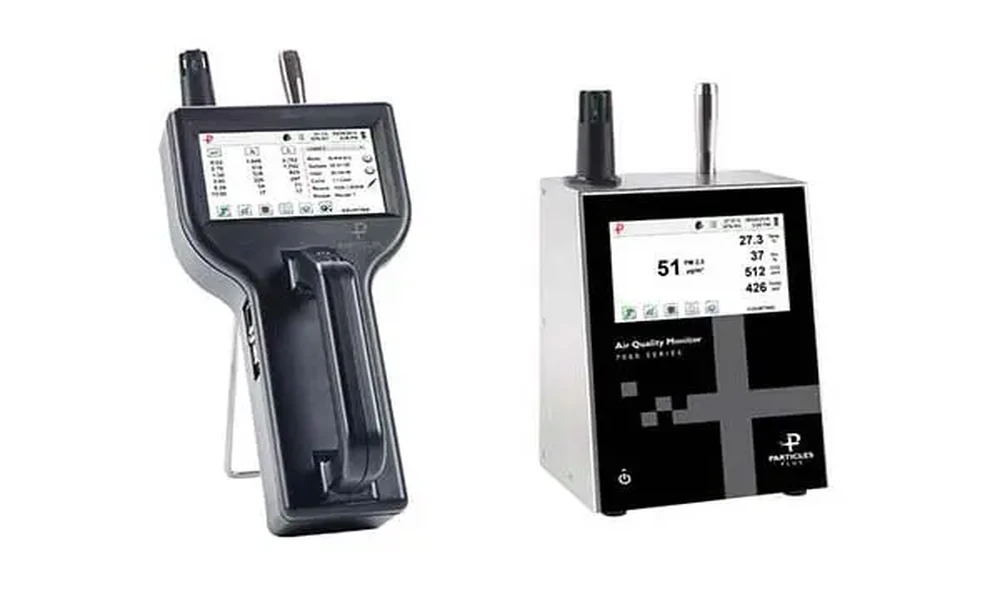
A particle counter is the instrument that makes invisible contamination measurable. In most working environments, the air carries thousands of particles per cubic metre at any given moment: fragments of skin, textile fibres, dust, combustion residue, and biological matter suspended at concentrations that vary with occupancy, activity, and ventilation. In environments where these particles cause failure, where a single contaminant can ruin a microchip, compromise a sterile pharmaceutical batch, or invalidate an aerospace component, measuring what the air contains is not an optional step. It is the foundation of contamination control.
How a Particle Counter Works
The operating principle of an optical particle counter relies on light scattering. A laser beam passes through a sensing zone, and air is drawn through that zone at a controlled flow rate. When a particle crosses the beam, it scatters light in a pattern that varies with the particle’s size. A photodetector collects the scattered signal, and the instrument’s electronics classify each particle according to the intensity of the light it scattered, which corresponds to its diameter.
A well-calibrated airborne particle counter produces a count in real time, showing how many particles of each size class passed through the sensor during the measurement period. The result is a direct count, expressed as particles per cubic metre or cubic foot, broken down by channel, typically at 0.3, 0.5, 1.0, 2.5, and 5.0 microns. Each channel tells a different story about the nature and source of the contamination present.
What Particle Size Reveals
Particle size is information. Particles below 1 micron in diameter are typically generated by combustion or chemical processes and penetrate deeply into the respiratory system. Particles between 1 and 5 microns include biological material, skin cells, and fine dust shed from surfaces and personnel. Particles above 5 microns, more readily captured by standard HEPA filtration, still pose a risk in sensitive manufacturing environments where any contamination above a threshold causes product failure.
Tracking which size channels are elevated helps diagnose the source of a contamination event. A spike in sub-micron particles following a maintenance activity suggests a chemical or thermal process. A rise in the 2.5 to 5 micron range correlates with personnel movement. Understanding the size distribution is what separates actionable contamination data from a raw number that cannot guide a response.
Cleanroom Classification and Compliance
The ISO 14644 standard classifies cleanrooms by the maximum allowable particle concentration at specific size thresholds. An ISO Class 5 cleanroom permits no more than 3,520 particles per cubic metre at 0.5 microns. An ISO Class 7 permits 352,000 at the same size. A particle counter is the instrument used to determine which class a room meets and to verify that it continues to meet that class during ongoing production. Without regular monitoring with a calibrated instrument, a room’s classification is a claim without evidence.
Pharmaceutical manufacturing requires particle monitoring not only for cleanroom classification but for batch release documentation. Regulatory bodies in major markets expect records showing that the environment in which a sterile product was manufactured met defined air quality conditions throughout the production run. An alarm that triggers when particle counts exceed a specified threshold, logged and time-stamped by the monitoring system, forms part of that compliance record.
Portable and Fixed Monitoring Configurations
Portable particle counters are used for commissioning tests, periodic qualification surveys, and fault-finding when contamination events occur. They can be positioned at any point in a room and moved as the test requires. Fixed monitoring systems with multiple remote probes provide continuous coverage of critical zones, with data transmitted to a central station where alarms can be configured and logged without the need for manual readings.
The choice between portable and fixed monitoring depends on the regulatory requirement and the nature of the process. A particle counter used for periodic ISO classification surveys can be portable. A system providing continuous environmental monitoring data for pharmaceutical batch records typically needs to be fixed, with validated data acquisition software and audit-trail functionality that a portable instrument cannot provide. Many facilities operate both: fixed monitoring for continuous compliance and portable instruments for investigation and qualification work.
Particle Monitoring in Singapore’s Controlled Environments
Singapore’s semiconductor fabrication facilities, biomedical manufacturing plants, and precision engineering workshops operate among the most demanding cleanroom environments in the Asia Pacific region. The technical standards applied in these industries follow international frameworks, and the monitoring instruments used must meet calibration and performance requirements traceable to recognised standards bodies. Local facilities that export to regulated markets in the United States, Europe, and Japan must demonstrate that their environmental monitoring data meets the requirements those markets impose.
“Singapore must continue to be a place where the best companies in the world want to set up their most advanced operations,” said Lee Hsien Loong, on the standard Singapore holds for its technology and manufacturing sectors. Particle monitoring is part of the infrastructure that makes that standard credible: not a process run only when required, but a continuous system of verification that supports every batch, every run, and every product shipped.
Contamination that cannot be measured cannot be managed, and contamination that cannot be managed produces failure at unpredictable intervals and without clear cause. The discipline of air quality monitoring is built on the premise that data from a calibrated, regularly maintained instrument gives a facility the information it needs to act before product is lost or compliance is breached. For any operation where air quality determines outcome, a particle counter is the instrument that converts an invisible environment into a set of numbers that can be understood, acted on, and documented.
