Most teams learn the same lesson the hard way once their AI assistant meets real users. The thing forgets. A customer walks through their entire setup on Monday, comes back Thursday, and starts over from zero. People read that as a model weakness. It rarely is. It is a memory design gap, and it gets fixed in the architecture, not the prompt. Getting llm long term memory right is what turns a forgetful demo into a product people actually rely on.
A bigger context window is not memory
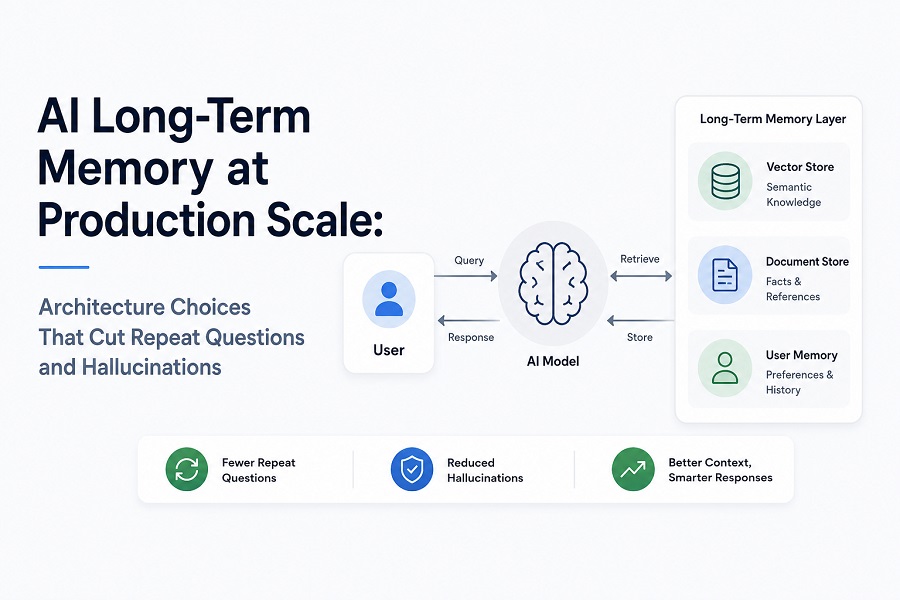
The first instinct is to widen the context window and shove the whole conversation back in on every call. It works for a demo. At real volume it gets slow, the token bill climbs fast, and everything still disappears the moment a session closes. Proper llm long term memory sits outside the model in a store you write to and read from on purpose. The cleanest mental model is simple. Treat the model as stateless. Treat memory as infrastructure you own.
The write path decides everything downstream
How you capture information shapes everything that follows. Two camps exist here. One stores raw transcripts and sorts it out later. The other extracts structured facts at the moment of writing, things like “prefers email over calls” or “runs on Postgres 14,” then embeds and indexes them. Raw storage gives you high recall and a lot of noise. Extracted memory is cleaner, cheaper to retrieve, and far easier to keep accurate over time. For production llm long term memory, the extraction approach almost always wins, because retrieval quality depends entirely on how disciplined you were up front.
The read path is where hallucinations actually drop
Hallucinations spike when a model is forced to guess. Give it nothing about the user and it will invent something that sounds plausible. A working read path does the opposite. On every query it retrieves the most relevant stored facts, ranks them, and injects only what matters into the prompt. Now the model answers from grounded data instead of filling gaps with fiction. This is the quiet reason llm long term memory cuts hallucinations. You are not making the model smarter. You are handing it the right facts at the right moment.
Update, do not just append
This is the part most early systems get wrong. Memory is not a log you keep adding to forever. People change jobs, switch tools, and update preferences. If your store appends a new fact without retiring the old one, retrieval starts returning contradictions and the model picks one at random. Good llm long term memory handles conflict resolution. When fresh information clashes with something already stored, the system updates or supersedes the stale entry instead of stacking both. Skip this and accuracy quietly rots as the dataset grows.
What the architecture buys you at scale
These choices compound inside a production llm long term memory system. Strong extraction plus precise retrieval plus conflict resolution gives you something where users stop repeating themselves and the assistant stops inventing details. Repeat questions fall because context carries across sessions. Hallucinations fall because answers stay anchored to verified facts. The operational wins follow close behind. Lower token spend, faster responses, and a store that grows without turning into a swamp.
A few things deserve attention once you are live. Retrieval precision matters more than retrieval volume, so pulling fifty memories when three are relevant just adds noise and cost. Latency budgets are real, since every lookup sits directly in the response path. And anything you persist about a person is a privacy and compliance question, so eviction rules and access controls belong in the design from day one, not bolted on later.
The takeaway
The pattern that holds up is not glamorous. Capture clean facts, retrieve them precisely, keep them current, and keep the model stateless. Teams that treat llm long term memory as core infrastructure rather than a feature added at the end are the ones whose assistants feel like they genuinely remember you. That gap is what separates a slick demo from something people trust in production.