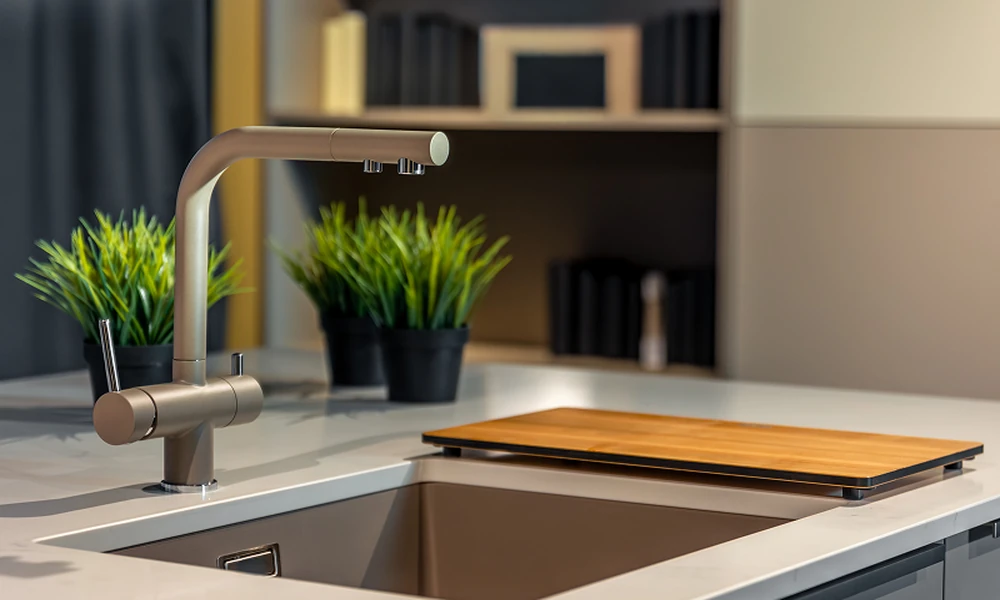
A kitchen tap needs to support frequent daily tasks while fitting the sink, countertop and surrounding cabinetry. Choosing one based only on appearance can create practical problems if the spout does not reach the basin properly or the installation requirements do not match the existing setup. When selecting a kitchen tap faucet, consider how you wash dishes, prepare food and fill containers before settling on a particular design.
1. Choose the Right Spout Reach
Spout reach affects where water lands in the sink. A short spout may work well for a compact basin, while a deeper sink may need greater reach.
Check the relationship between the tap position and sink dimensions before buying. The water stream should reach a useful area of the basin without creating unnecessary splashing.
If you have a double-bowl sink, consider whether the spout movement provides enough coverage for your routine tasks.
2. Compare Spout Height
Spout height determines the clearance available for washing larger items. Tall designs can make it easier to position pots or containers beneath the outlet, while lower profiles may suit kitchens with limited overhead space.
Consider the sink depth and the surrounding cabinetry. A high tap should still fit comfortably within the available area.
Think about the objects you regularly wash rather than choosing height based on appearance alone.
3. Review Handle Controls
Handle design affects everyday usability. Single-lever taps allow users to control flow and temperature with one hand, while other designs may use separate controls.
Consider how you normally use the sink. If you frequently operate the tap while holding an item, an easy-to-reach control can make routine tasks more convenient.
The control position should also leave enough space around the tap for comfortable operation.
4. Check Installation Requirements
Before purchasing, confirm how the tap will be installed. Check the number and size of countertop or sink openings, mounting requirements and available clearance beneath the worktop.
If you are replacing an existing tap, do not assume the new model will fit the existing opening. Verify dimensions and installation specifications first.
Professional installation of a kitchen tap in Singapore may be appropriate where plumbing changes or modifications are required.
5. Compare Finishes and Cleaning Needs
Tap finishes influence the appearance of the kitchen and the amount of visible water marks or fingerprints. Consider how the finish works with the sink, handles and other hardware.
Ask about recommended cleaning methods. Abrasive products or unsuitable chemicals may affect some finishes.
A practical finish should suit the way your household uses and maintains the kitchen rather than simply matching current trends.
6. Consider Everyday Usability
Think through routine tasks such as filling bottles, washing vegetables, cleaning cookware and rinsing the sink.
A kitchen tap should provide sufficient movement, clearance and water control for these activities. If the sink is positioned beneath a window or close to another fixture, check that the tap’s movement does not create an obstruction.
Feature Comparison
| Feature | What to check |
| Spout reach | Does water land in a useful part of the sink? |
| Spout height | Is there enough clearance for cookware? |
| Handle | Can it be operated comfortably? |
| Installation | Do the mounting requirements match the sink or worktop? |
| Finish | Does it suit the kitchen and cleaning routine? |
| Movement | Does the spout provide adequate sink coverage? |
The right tap should support everyday kitchen work while fitting the physical requirements of the sink and countertop. Reviewing these features before buying a kitchen tap faucet can reduce the risk of choosing a design that looks suitable but proves inconvenient in use.
Contact 360 Bathware to discuss a kitchen tap in Singapore and review options for your kitchen setup.

Clare Louise is a technology writer who focuses on digital trends, emerging tools, and practical tech insights. She simplifies complex innovations into easy-to-understand concepts, helping readers stay informed and confident in a rapidly evolving digital world.