Choosing a desktop UV printing machine is an important decision for a growing customization business. While print quality matters, production speed, operating costs, material compatibility, and the ability to handle different product types can have an even greater impact on daily business.
The LONGER ePrint and Morpho UV Printer are two new-generation desktop UV printing systems designed for creators and small businesses. Both offer advanced features, but their approaches to production are different.
For businesses looking for a UV printer for small business applications that combines production efficiency with multiple printing processes, LONGER ePrint offers several advantages.
LONGER ePrint vs. Morpho: Key Specifications
| Feature | LONGER ePrint | Morpho UV Printer |
|---|---|---|
| Printhead | 2 × Epson F1080 | F1080 / i3200 |
| Ink Channels | 12 | 6 / 8 |
| Resolution | Up to 1440 DPI | Up to 2400 DPI |
| Standard Print Area | 310 × 420 mm | 330 × 220 mm |
| Extended Print Area | – | 420 × 330 mm A3 bed |
| Printing Processes | UV, DTF, DTG, UV DTF | UV printing |
| 3D Texture | Up to 15 mm | Up to 5 mm F1080 / 60 mm i3200 |
| Third-Party Ink | Supported | Refillable ink supported |
| Current Listed MSRP | From $2,499 | $2,699 F1080 / $4,999 i3200 |
Specifications can vary by configuration.
1. Printing Performance: Dual Heads for Production Efficiency
For businesses, printing performance is not simply about maximum print resolution. The ability to complete more jobs efficiently can be equally important.
LONGER ePrint uses two Epson F1080 printheads and 12 ink channels. LONGER states that the dual-head configuration can achieve 2× faster 2D printing and up to 6× faster 3D texture printing compared with its single-head configuration. Its listed print speeds are up to 4 m²/h depending on pass count and printing mode.
This makes the ePrint particularly relevant when a small business moves from occasional personal projects to regular customer orders.
Morpho takes a different technical approach. Its F1080 model uses a six-channel configuration, while the i3200 model uses eight channels and supports up to 2400 DPI. The i3200 printhead also typically costs more than $1,200 per unit, making printhead replacement a significant consideration for long-term operating costs. By comparison, the LONGER ePrint uses the F1080 printhead, which costs less than $400 per unit, offering a lower-cost option for maintenance and replacement.
In practice, production speed depends on resolution, pass count, artwork, ink configuration, and print mode. Businesses should therefore compare performance based on their actual products rather than a single headline speed.
2. More Than UV Printing: ePrint Expands the Production Workflow
One of the biggest advantages of LONGER ePrint is that it is designed as a 4-in-1 UV printing machine.
The ePrint supports:
UV printing
DTF printing
DTG printing
UV DTF printing
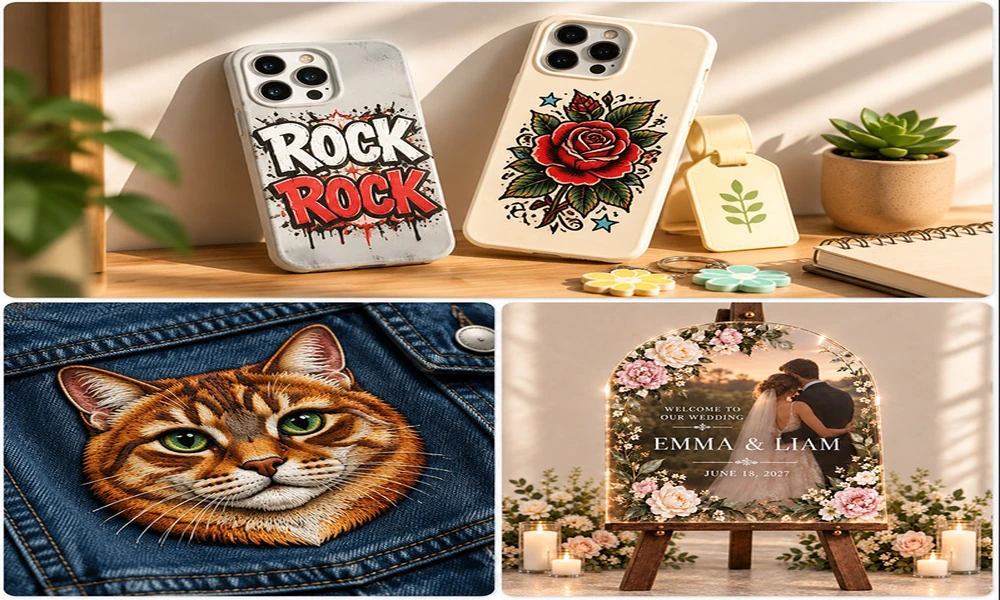
This means one machine can serve different product categories, from acrylic, wood, glass, and metal to leather, canvas, apparel, and transfer films.
For a UV printer for small business, this flexibility can be particularly valuable.
A business may start with personalized phone cases and signs, then add custom apparel, UV DTF decals, promotional products, or textured gifts. With ePrint, these applications can be explored without immediately purchasing another specialized printer.
Morpho focuses more heavily on advanced UV printing, automated sensing, enclosed printing, and specialty effects.
The key difference is therefore not simply which machine can produce a particular print, but how many different production workflows a business can build around one machine.
3. Operating Cost: Open Ink Flexibility
The purchase price is only one part of the cost of owning a desktop UV printing machine. Ink consumption, replacement frequency, maintenance, and the ability to choose consumables can all affect long-term operating costs.
LONGER ePrint uses 12 × 200 ml ink cartridges in its dual-head configuration and supports third-party inks. LONGER positions this open ink system as a way to give users more choice and potentially lower operating costs.
Morpho also supports refillable ink cartridges and publishes ink pricing for its system. Its current site lists 130 ml CMYK ink at $13.99 under its stated Kickstarter launch pricing, with white and varnish ink available in 290 ml cartridges.
Actual ink cost per product will depend heavily on artwork coverage, white-ink usage, texture effects, cleaning, and printing settings. Therefore, businesses should calculate cost per finished product rather than comparing ink prices alone.
For users who want the freedom to evaluate different ink suppliers, ePrint’s third-party ink compatibility provides an additional level of flexibility.
4. Production Flexibility and Material Range
A production machine should also accommodate the products a business expects to sell.
LONGER ePrint supports printing on 300+ materials, including wood, metal, acrylic, plastic, fabric, glass, ceramic, stone, leather, and film. Its standard platform provides a 310 × 420 mm printing area.
It also supports five production modes, including flatbed, rotary, transfer-film, roll-to-roll, and conveyor-belt printing.
Morpho offers a 330 × 220 mm enclosed printing area and can expand to a 420 × 330 mm A3 print bed. Its moving-gantry architecture and sensing system are designed around automated positioning and product detection.
For businesses that sell many different customized products, ePrint’s combination of material compatibility and multiple printing processes can reduce the need to build a production setup around several machines.
5. 3D Texture and Specialty Printing
Both machines support dimensional printing, but they approach it differently.
LONGER ePrint can create up to 15 mm colorful 3D relief and offers more than 20 printing effects, including embossing, high-relief printing, embroidery effects, fluorescent effects, lenticular effects, and other specialty applications.
Morpho’s i3200 model advertises up to 60 mm embossment height, while its F1080 model lists up to 5 mm.
For businesses primarily focused on extremely deep embossing, these specifications deserve close attention. For businesses looking for a combination of 3D texture and multiple production processes, ePrint provides a broader workflow.
6. Which Desktop UV Printing Machine Makes Sense for Production?
The right choice depends on the type of production a business expects.
Morpho emphasizes an enclosed printing environment, automated sensing, high-resolution imaging, and an upgrade path to its i3200 configuration. LONGER ePrint focuses on combining dual-head production, multi-process printing, flexible ink configurations, and broad material compatibility.
For small businesses that need one machine to support multiple product categories, ePrint’s combination of 12 ink channels, dual printheads, UV/DTF/DTG/UV DTF workflows, 300+ supported materials, and third-party ink compatibility makes it a versatile production platform.
Rather than choosing a printer solely by maximum DPI or maximum texture height, businesses should consider how the machine fits their complete production workflow.
Conclusion
The LONGER ePrint and Morpho UV Printer represent two different approaches to desktop UV printing.
Morpho focuses on advanced UV printing hardware, automated sensing, and an enclosed production environment. LONGER ePrint places greater emphasis on multi-process production and operational flexibility.
For entrepreneurs building a customization business, the ability to print different products, experiment with new applications, and increase production capacity without immediately adding another machine can be an important consideration.
With its dual-head architecture, 12-channel ink system, 4-in-1 printing capabilities, open ink system, 300+ material compatibility, and 15 mm 3D color relief, LONGER ePrint is designed to give small businesses more ways to turn one desktop UV printing machine into a flexible production platform.
Morpho is currently in the crowdfunding stage, so its delivery timeline remains subject to some uncertainty. In comparison, the LONGER ePrint began shipping at the end of September, with units already entering fulfillment.

Clare Louise is a technology writer who focuses on digital trends, emerging tools, and practical tech insights. She simplifies complex innovations into easy-to-understand concepts, helping readers stay informed and confident in a rapidly evolving digital world.